
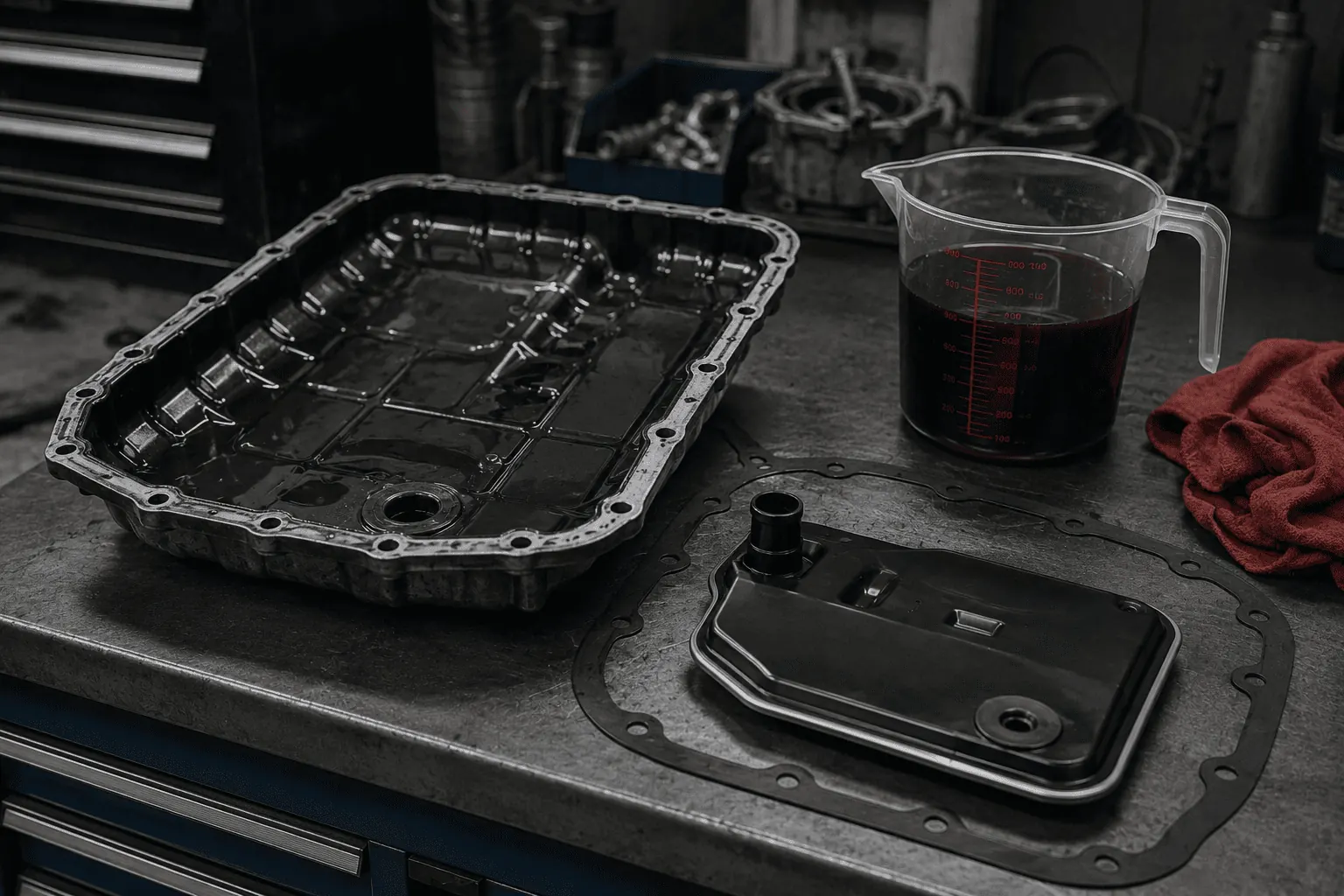
Transmission faults are among the most expensive repairs on a car and among the most preventable. Fluid that has never been changed is the single most common cause of a failure that a service would have avoided.
We diagnose slipping, harsh shifts, delayed engagement and noise, and we are straight with you about the point where a repair stops making economic sense against the value of the vehicle.
Transmission fluid does more jobs than engine oil does. It lubricates, it carries heat out to the cooler, it operates the clutches hydraulically, and in a torque converter it is the drive coupling itself. As it ages it oxidises and loses the friction modifiers that let clutch packs grab cleanly, which is why a worn fluid shows up first as a shift that feels late or slurred rather than as a noise. Heat is what ages it, and heat comes from towing, from hills, and from stop-start traffic — which is to say from ordinary driving here.
The phrase "sealed for life" causes more transmission failures than any single mechanical fault. It means there is no dipstick, not that the fluid is immortal, and the life it refers to is the warranty period rather than yours. We check the manufacturer's actual service schedule for your vehicle rather than taking the absence of a dipstick as an instruction. Where a transmission is already slipping badly, we will say so plainly: at that point fresh fluid is not a repair, and the honest conversation is about rebuild or replacement against what the car is worth.
What the service covers
- Transmission fluid and filter service
- Diagnosis of slipping and shift faults
- Automatic and manual transmissions
- Honest assessment of repair vs. replace
Signs you need transmission service
- The engine revs climb without the car accelerating to match
- A delay between selecting drive or reverse and the car moving
- Shifts that thump, flare, or hunt between gears
- A burnt smell, or fluid that is dark brown rather than red
- Whining, humming, or a shudder at steady cruising speed
- On a manual: a clutch that slips, judders, or a gear that grinds going in
What affects the cost
Every job is quoted before we start. These are the things that move the number — call the shop and describe the car and we will give you the figure for yours.
- Whether the job is a fluid and filter service or a diagnosis of an internal fault
- How much fluid the unit takes, and whether it needs a manufacturer-specific type — transmission fluids are not interchangeable
- Whether the pan comes off for a filter, or the unit uses a spin-on filter and a drain plug
- Whether the fault is in the valve body, the solenoids, or the clutch packs — three very different repairs
- The value of the vehicle, which is the number that decides whether a rebuild makes sense at all
Transmission Service questions
How often should transmission fluid be changed?
Check the schedule for your specific vehicle — the figure varies widely, and it shortens considerably if you tow, drive hills, or sit in stop-start traffic. What matters more than any single number is that the interval exists: a transmission that has never had its fluid changed is the single most common cause of a failure that a service would have prevented.
My transmission is "sealed for life" — does it still need servicing?
"Sealed for life" means there is no dipstick, not that the fluid never degrades. Most sealed units still have a manufacturer service interval, it is just published in the schedule rather than implied by a dipstick under the bonnet. We look up the actual schedule for your vehicle rather than assuming the absence of a dipstick is an instruction.
Will changing the fluid fix my slipping transmission?
Sometimes, if the slip is caused by degraded fluid caught early. Often not — once clutch material has worn away, the friction is gone and no fluid restores it. We will tell you honestly which situation the evidence points to rather than selling you a service that has little chance of working.
What does it mean if the fluid is dark or smells burnt?
Healthy automatic transmission fluid is translucent red. Dark brown fluid has oxidised. A burnt smell means clutch material has overheated, and the particles you can smell are friction material that is no longer on the clutches. Neither finding is fatal on its own, but both change what the right next step is.
Do you work on manual transmissions too?
Yes — clutches, gearbox oil, and diagnosis of grinding, slipping and selection faults on manual as well as automatic transmissions, across both foreign and domestic makes.