
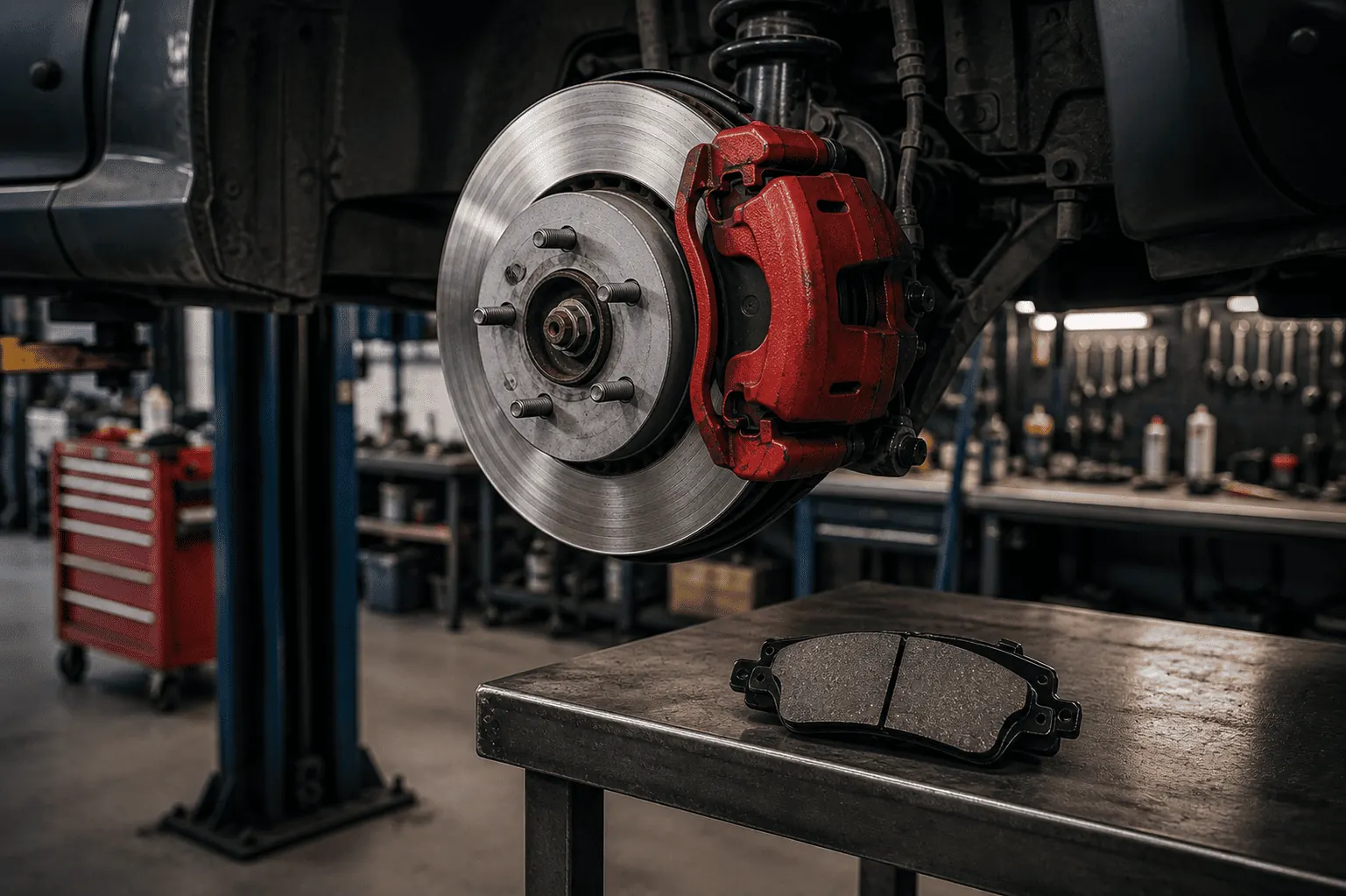
Brakes fail gradually and quietly. Pads thin, fluid absorbs moisture, discs develop a lip — and because the change happens over months, most drivers adapt to a longer stopping distance without noticing they have.
We diagnose the whole system rather than replacing the obvious part: pads, discs, calipers, lines and fluid. You get told which parts are worn now, which will need attention at the next service, and which are fine.
Brake fluid is the part of the system drivers never think about and the part that quietly sets the ceiling on how well everything else works. It is hygroscopic — it pulls moisture out of the air through the flexible lines over time — and water boils at a far lower temperature than fluid does. On a long descent off the Coquihalla or coming down from Cypress, fluid that has absorbed a few percent water can boil, and boiling fluid puts compressible vapour into a system that only works because it is incompressible. The pedal goes to the floor at precisely the moment you need it not to.
Rust is the local variable. Wet winters on salted roads seize caliper slide pins and corrode disc faces, and a caliper that cannot slide holds one pad against the disc permanently. That pad wears out in a fraction of its life, the disc overheats and warps, and the car pulls under braking. It is one of the most common faults we see on cars that have spent their lives in the Lower Mainland, and it is also one of the cheapest to prevent if it is caught while the pins will still free off.
What the service covers
- Full brake system inspection
- Pad, disc and caliper replacement
- Brake fluid check and flush
- Handbrake adjustment
Signs you need brake repair
- Squealing that appears when you brake and disappears when you stop — usually the wear indicator doing its job
- Grinding, which normally means the pad material is gone and metal is on metal
- A pedal that feels soft, spongy, or travels further than it used to
- The car pulling to one side under braking
- Vibration through the pedal or steering wheel when slowing from speed
- The brake warning light staying on after you release the handbrake
What affects the cost
Every job is quoted before we start. These are the things that move the number — call the shop and describe the car and we will give you the figure for yours.
- Which axle: front brakes do most of the work and wear faster, and doing one axle costs less than doing both
- Whether the discs can be left alone or have worn past their minimum thickness and need replacing with the pads
- Whether a caliper has seized, which turns a pad-and-disc job into a caliper job
- The vehicle: performance and heavier vehicles use larger, more expensive components
- Whether the fluid is due a flush at the same time, which is cheaper done together than separately
Brake Repair questions
How do I know if my brakes need doing?
Squealing under braking is usually the wear indicator, a small metal tab designed to contact the disc and make a noise while there is still pad left. Grinding is later and worse — that is metal on metal, and it damages the disc as well as the pad. A soft or long pedal, pulling to one side, or vibration when slowing all point at the system too. Any of them is worth a call rather than a wait.
Is it safe to keep driving on grinding brakes?
No. Grinding means the friction material is gone and the pad backing plate is cutting into the disc. Stopping distances are already longer than they should be, the damage is getting more expensive every time you drive, and the failure mode from here is sudden rather than gradual. This is the one repair worth not postponing.
How often should brake fluid be changed?
Most manufacturers specify every two to three years regardless of mileage, because the interval is set by moisture absorption rather than wear. Fluid that has taken on water boils at a lower temperature, and boiling fluid puts compressible vapour into the lines — which is how a pedal that felt fine all week goes to the floor at the bottom of a long hill.
Do I need to replace the discs as well as the pads?
Only if they have worn past the minimum thickness stamped on the disc, or if they are scored, cracked, or heat-damaged. Discs that are still within specification and running true can be left alone. We measure rather than assume, and tell you which case yours is in before we order parts.
How long does brake work take?
It depends entirely on what the inspection finds — pads on one axle is a very different job from a seized caliper or corroded lines. Call the shop, describe what the car is doing, and we will tell you what it is likely to be and how long we would need the car for.