
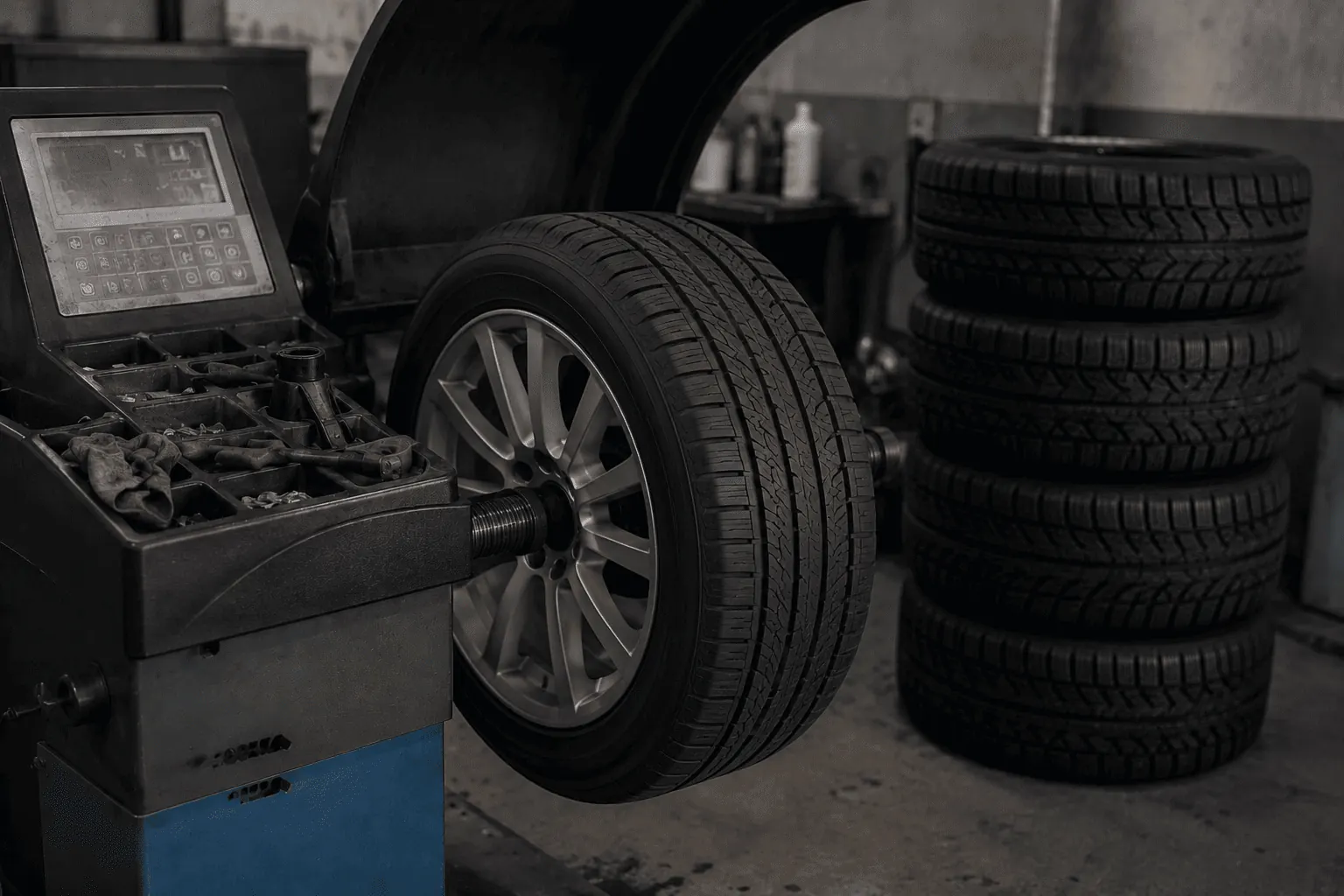
Tires are the only part of the car that touches the road, and they wear unevenly if rotation and alignment are neglected. Rotating on schedule is the cheapest way to get the full life out of a set.
We handle fitting, balancing, rotation, puncture repair where the damage allows it, and the seasonal changeover between summer and winter rubber.
Winter tires in British Columbia are a legal requirement rather than a preference on many routes. From 1 October to 30 April, designated highways — including the Coquihalla, the Sea to Sky, and most routes through the interior — require either a mountain snowflake symbol or a mud-and-snow tire with at least 3.5 mm of tread. The two are not equivalent in practice: the mountain snowflake is awarded on tested performance in severe snow, while M+S describes a tread pattern. The real difference is the rubber compound. Below about 7°C a summer tire hardens and loses grip on dry pavement as well as on snow, which is why the changeover is worth doing across the Lower Mainland even where no sign requires it.
Rotation is the cheapest maintenance on this list and the most often skipped. Front tires on a front-wheel-drive car carry the steering, the driving and most of the braking, so they wear roughly twice as fast as the rears. Moving them on schedule evens that out and gets the full life from the set instead of half of it from two. It is also the moment we see the wear pattern across all four — feathering, one-shoulder wear, or cupping each point at a specific alignment or suspension fault, and reading them early is how an alignment gets corrected before it costs you a set of tires.
What the service covers
- Fitting and computer balancing
- Rotation on schedule
- Puncture repair where safe to do so
- Seasonal winter tire changeover
Signs you need tire & wheel services
- Tread worn to or near the wear bars moulded into the grooves
- Wear heavier on one shoulder than the other, or scalloped across the tread
- Vibration through the steering wheel that appears at a particular speed
- The car pulling to one side on a flat, straight road
- The tire pressure warning light coming on repeatedly
- Cracking in the sidewall, or a set more than six years old regardless of tread
- October coming round and the winter set still stacked in the garage
What affects the cost
Every job is quoted before we start. These are the things that move the number — call the shop and describe the car and we will give you the figure for yours.
- Tire size and speed rating — larger diameters and higher ratings cost more
- Whether the wheels need the tire changed on the rim or you run a second set of wheels, which makes the seasonal swap a much quicker job
- Whether the vehicle has TPMS sensors that need servicing or reprogramming when tires are changed
- Whether a puncture can be safely repaired or the tire has to be replaced
- How many corners: rotation and balancing are priced by the set, fitting by the tire
Tire & Wheel Services questions
When do I legally need winter tires in BC?
On designated BC highways, winter tires are required from 1 October to 30 April. Signs mark those routes, and they cover most mountain passes and interior highways — the Coquihalla and the Sea to Sky among them. The tire must carry either the mountain snowflake symbol or an M+S marking with at least 3.5 mm of tread remaining.
Are M+S tires the same as winter tires?
They are legally accepted on BC's designated routes, but they are not equivalent. M+S describes a tread pattern; the mountain snowflake is awarded on tested performance in severe snow, and the tires that carry it use a compound that stays pliable in the cold. On ice and packed snow the difference is substantial.
How often should tires be rotated?
Roughly every 8,000 to 10,000 km, or at every oil change, which is the easiest way to remember it. Fronts on a front-wheel-drive car steer, drive and do most of the braking, so they wear about twice as fast as the rears — rotating evens that out and gets the full life from the set.
Can my puncture be repaired?
If the puncture is in the tread area, smaller than about 6 mm, and the tire has not been run flat, then usually yes — properly repaired from the inside with a patch-plug rather than an external plug. Sidewall and shoulder damage cannot be safely repaired, and neither can a tire that has been driven on while flat. We will tell you which yours is.
How long do tires last if the tread is still good?
Rubber ages whether or not the car is driven. Most manufacturers recommend replacement at six years and consider ten an absolute limit regardless of tread depth, because the compound hardens and the sidewall develops fine cracks. The four-digit date code on the sidewall gives the week and year of manufacture.