
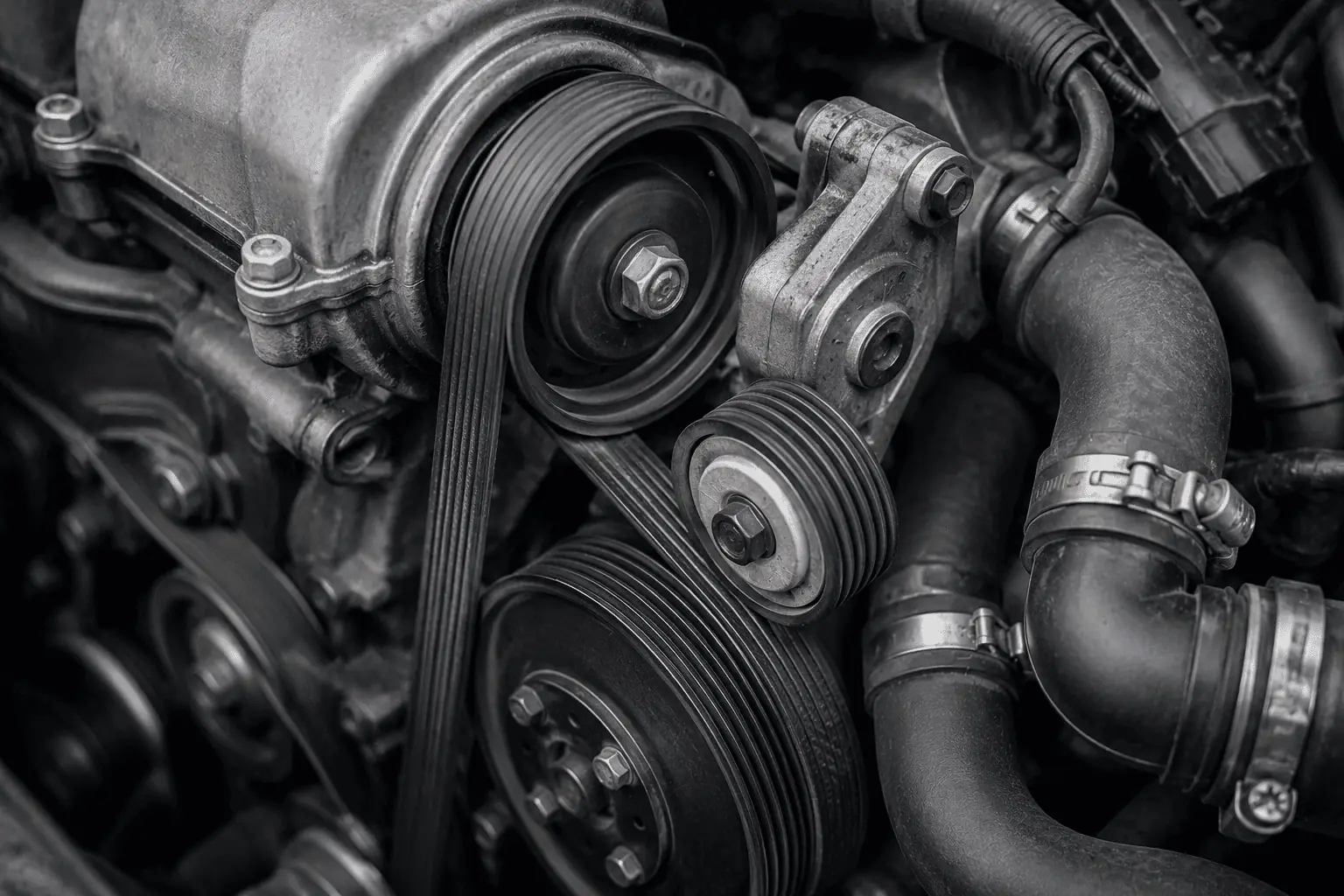
Belts and hoses are rubber, and rubber perishes on a timetable regardless of mileage. A drive belt that snaps leaves you without steering assistance and charging; a timing belt that goes on an interference engine can end the engine.
We inspect them at every service and replace on the manufacturer's interval rather than waiting for the failure that the interval exists to prevent.
The distinction worth understanding is between the two kinds of belt. The drive belt — the serpentine, on the outside of the engine — turns the alternator, the water pump on many engines, the power steering and the air conditioning compressor. When it goes you lose charging and steering assistance, usually along with cooling, and you get a warning: a squeal on start-up, or cracks visible across the ribs. The timing belt is inside the engine, keeping the crankshaft and camshafts turning in step. It gives no warning at all, and on an interference engine — which most modern engines are — a failure lets the pistons meet the valves. That is an engine rebuild arriving in the time it takes a belt to snap.
Because the timing belt gives no warning, its replacement is scheduled by time and mileage rather than by inspection, and the interval is not advisory. It is also the moment to replace the tensioner, the idler pulleys and usually the water pump, since they are behind the same covers and their remaining life is shorter than the new belt's — doing them separately means paying the same labour twice. Hoses follow the same logic on a different clock: rubber perishes with heat cycles and age regardless of mileage, and a hose that feels spongy, rock-hard, or swollen near a clamp is a roadside coolant loss waiting for a hot day.
What the service covers
- Drive and timing belt inspection
- Replacement on manufacturer interval
- Coolant hose and clamp check
- Tensioner and pulley assessment
Signs you need belts & hoses
- A squeal from the engine bay on start-up or when the steering is turned to full lock
- Visible cracks, glazing, or missing ribs on the drive belt
- Coolant hoses that feel spongy, brittle, or swollen near the clamps
- Coolant loss with no obvious puddle, or a sweet smell after a run
- The engine running warmer than it usually does
- The timing belt interval has passed, or you do not know whether it has
What affects the cost
Every job is quoted before we start. These are the things that move the number — call the shop and describe the car and we will give you the figure for yours.
- Which belt: a drive belt is a straightforward job, a timing belt means dismantling the front of the engine
- How accessible the engine is — a transverse engine in a tight bay takes considerably longer
- Whether the tensioner, idlers and water pump are replaced at the same time, which is cheaper together than separately and is usually the right call
- How many hoses are involved and whether any have to come off to reach something else
Belts & Hoses questions
What is the difference between a timing belt and a serpentine belt?
The serpentine or drive belt runs on the outside of the engine and turns the accessories — alternator, power steering, air conditioning, often the water pump. The timing belt is inside, keeping the crankshaft and camshafts synchronised. The drive belt warns you before it fails; the timing belt does not, which is why one is replaced on inspection and the other on a schedule.
What happens if a timing belt breaks?
On an interference engine — most modern engines — the pistons and valves occupy the same space at different moments, and only the belt keeps them apart. If it snaps, they meet. Bent valves and damaged pistons follow, and the repair is an engine rebuild. On a non-interference engine the car simply stops, which is inconvenient rather than expensive. Either way the belt gives no warning first.
How often does a timing belt need replacing?
It varies by engine, so the interval in your manual is the one that matters, expressed in both mileage and years — the belt ages whether or not you drive it. Many engines now use a timing chain instead, which is designed to last the life of the engine. If you are not sure which your car has, call with the make, model and year and we will tell you.
Should I replace the water pump at the same time?
Usually yes, and on engines where the timing belt drives the pump it is close to mandatory. The pump sits behind the same covers, so almost all of the labour is shared. Replacing it later means paying that labour a second time, and a pump that fails afterwards can take the new belt with it.
My belt squeals when I start the car. Is that urgent?
It is a warning worth acting on rather than an emergency. A squeal usually means the belt is glazed, cracked, or the tensioner is weak. Left alone it will eventually shred, and when it does you lose charging and steering assistance at the same moment — often along with the water pump. It is a cheap part to replace before that.